A dangerous passion
Are World Cup matches associated with a change in healthcare-seeking behavior?
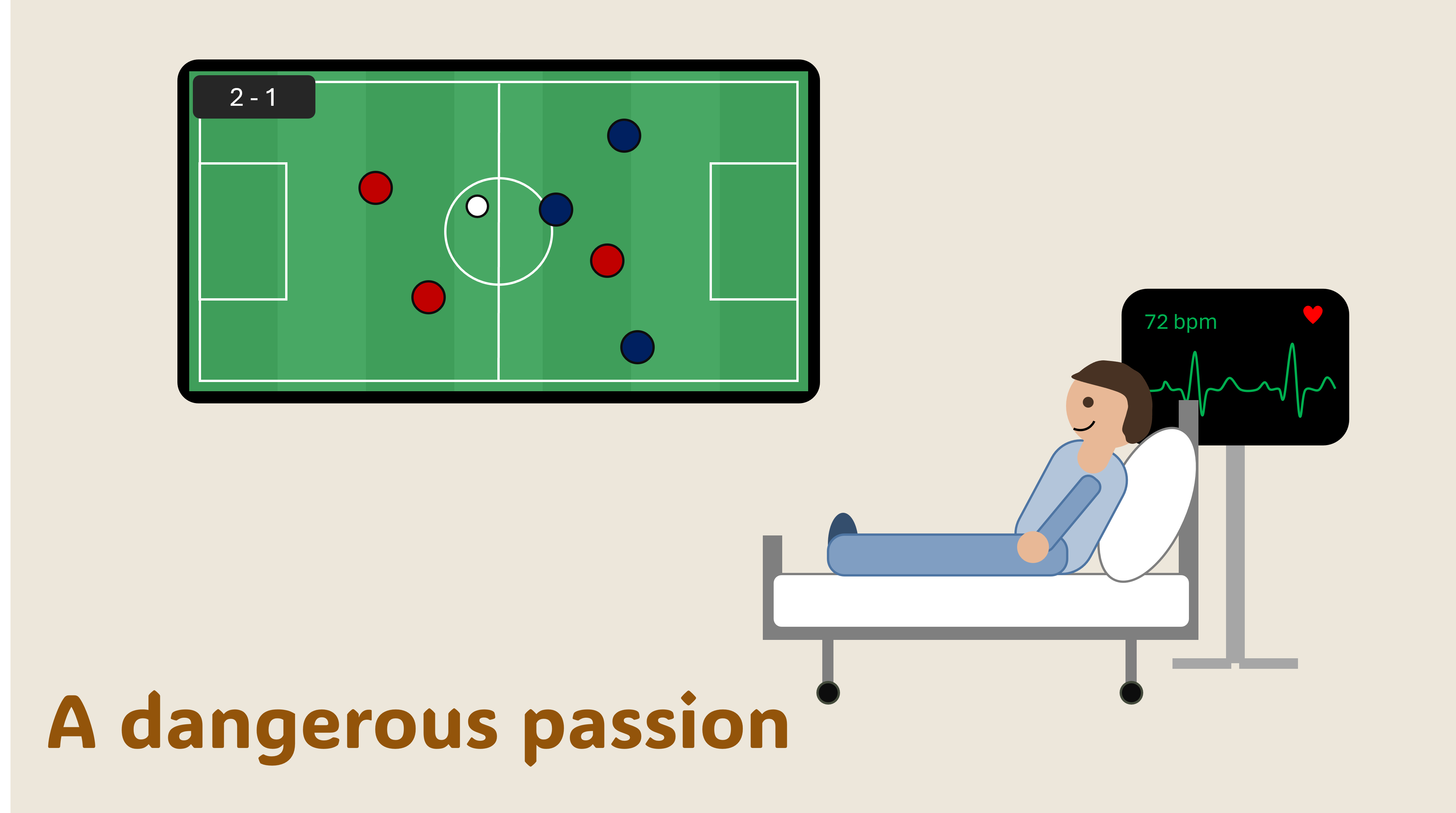
Let’s talk about: the potential changes observed in healthcare-seeking behavior associated with cardiovascular issues during World Cup matches.
Research question and objectives

The FIFA World Cup 2026 ⚽ has attracted a massive global audience, with more than 50 million viewers worldwide tuning in during the opening weekend alone. These remarkable figures reflect just how passionate people are about football – well… not me…🫣 (source: https://inside.fifa.com/tournament-organisation/fifa-world-cup-2026-by-the-numbers).
The question is: could this passion affect our health?
Interestingly, it has been observed that fewer adults visit emergency departments during major sporting events (Ballesteros Pena et al. 2020, Barut et al. 2025, Almeida et al. 2014). It seems that most people would rather delay seeking medical care than miss an important match… 🤦
At the same time, the emotional excitement surrounding these competitions, particularly during high-stakes matches, may also potentially contribute to acute cardiovascular issues. Indeed, previous studies have reported an increase in cardiac emergencies or visits for cardiovascular complaints on match days, particularly when the local team loses 😬 (Carroll et al. 2002, Wilbert-Lampen et al. 2008).
In this study, the authors wondered whether these two mechanisms (healthcare-seeking avoidance and an increase in stress-triggered cardiac events) were observed in the Brazilian population 🇧🇷, where football ⚽ is deeply rooted in the national culture.
A brief presentation of the methodology

To conduct their study, the authors collected specific data from the Sistema de Informacoes Hospitalares do Systema Único de Saúde (SIH-SUS), the Brazilian information system that records hospital admissions covered by the public healthcare system.
They focused on the daily counts of hospital admissions for two cardiovascular conditions ❤️🩹:
- acute myocardial infarction (AMI), commonly known as a heart attack
- heart failure (HF), a condition in which the heart cannot pump blood as effectively as it should
The authors were interested in the 3 previous FIFA World Cup tournaments ⚽ in which Brazil 🇧🇷 participated: 7 matches in 2014, 5 matches in 2018 and 5 matches in 2022. It should be noted that Brazil was the host nation in 2014. Of these 17 matches, Brazil won 10, drew 2, and lost 5.
They looked at periods covering a window of 30 days preceding and following each tournament, allowing for a more robust assessment of the actual impact of each match.
To assess the potential association between these match days involving the Brazilian national team and the number of cardiovascular-related hospitalizations, the authors used negative binomial regression models.

The authors observed a 7% and 11% reduction in AMI and HF admissions, respectively, on days when Brazil played compared with non-match days.
Although these reductions may appear relatively small, they were found to be statistically significant, meaning that the observed differences were unlikely to be coincidental.
Interestingly, AMI and HF hospitalizations were even lower on days when Brazil won than on days when the national team lost or drew their match, although this finding was not significant.
No consistent increase in AMI or HF admissions was observed during the 3 days following Brazil’s matches. Instead, there was a progressive return to baseline hospitalization levels. This result suggests that there is no clear evidence of a rebound in cardiovascular-related hospitalizations after World Cup tournaments.
Unfortunately, the authors were unable to determine whether, beyond potential changes in healthcare-seeking behavior, the risk of AMI or HF may have increased on match days, as they did not account for overall hospital visit volume. Consequently, they could not establish whether cardiovascular admissions represented a larger proportion of all hospital admissions relative to other causes on match days. However, previous studies have reported an increase in cardiac emergencies during major sporting events (Carroll et al. 2002, Wilbert-Lampen et al. 2008).
Although the SIH-SUS databased used in this study covers a substantial proportion of the Brazilian population (approximately 75%, Pimentel et al. 2023, Brazilian Ministry of Health 2025), caution is needed when extrapolating these findings to the global population.
🧩 Putting everything together
Taken together, these results are consistent with previous observations that people are less incline to seek medical care during major sporting events. However, given the study limitations, the findings cannot be interpreted as a proven increase in the incidence of cardiovascular events on match days.
In other words: please, do not put off seeking medical attention just because your fav’ team is playing!!
Read the article: Ades R, Shusterman V. (2026) Watching the Game, Skipping the Hospital: World Cup Matches and Cardiovascular Hospitalizations. Cardiol Res;17(5): 459-465 (https://doi.org/10.14740/cr2271)
Cited references:
- Almeida A, Eusebio M, Almeida J, Boattini M. (2014) The impact of the Lisbon Football Derby on the profile of emergency department admissions. Acta Med Port;27(6):700-703
- Ballesteros Pena S, Fernandez Aedo I, Vallejo de la Hoz G. (2020) Impact of football matches on number of visits to an emergency department. Emergencias;32(5):345-348
- Barut E, Barut K. (2025) The effect of football derbies on emergency department visits: evidence from Turkey, 2024. J Epidemiol Glob Health;15(1):125
- Brazilian Ministry of Health, Pan American Health Organization. (2025) Special report on social participation in health and climate: supporting document for the implementation of the belem health action plan. 1st ed. Brazilian Ministry of Health
- Carroll D, Ebrahim S, Tilling K, Macleod J, Smith GD. (2002) Admissions for myocardial infarction and World Cup football: database survey. BMJ;325(7378):1439-1442
- Pimentel FG, Buchweitz C, Onocko Campos RT, Hallal PC, Massuda A, Kieling C. (2023) Realising the future: Health challenges and achievements in Brazil. SSM - Mental Health;4:100250
- Wilbert-Lampen U, Leistner D, Greven S, Pohl T, Sper S, Volker C, Guthlin D, et al. (2008) Cardiovascular events during World Cup soccer. N Engl J Med;358(5):475-483