The energy cost of locomotion
Study the energy cost of bonobos’ locomotion to better understand the origins of Human’s bipedalism.
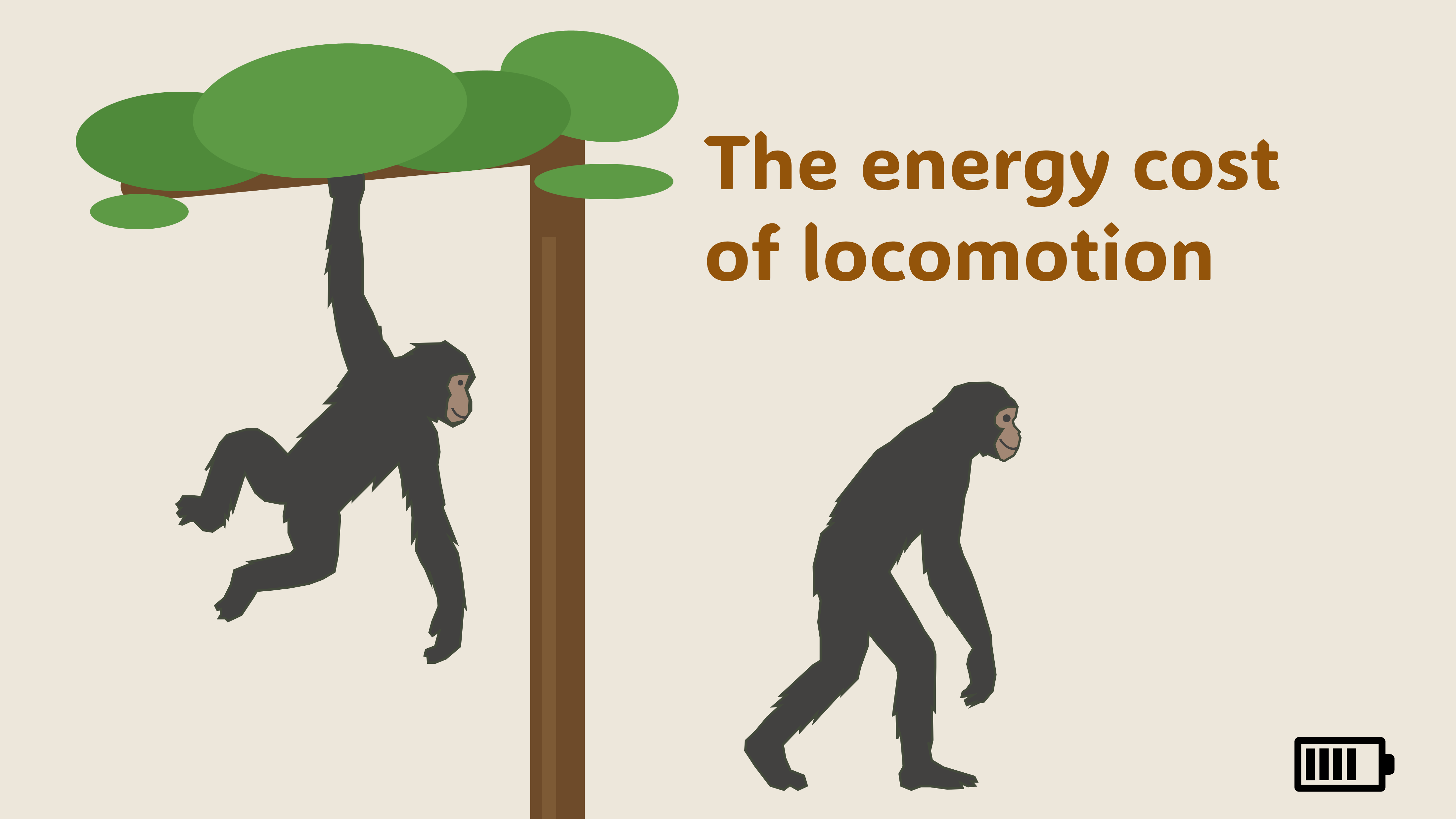
Let’s talk about: new hypotheses about the origins of Human’s bipedalism, investigated through the study of the energy cost associated with the bonobo’s locomoto repertoire.

Research question and objectives

The human lineage differs from other great apes in several ways, including its mode of locomotion: exclusive bipedalism, that is, moving exclusively on the two lower limbs. However, bipedalism is not unique to humans: it is also found in other animal species, although it takes different forms. Birds, for instance, are fully bipedal when moving on the ground 🐦⬛.
In our closest relatives, the great apes 🐒, the locomotor repertoire is diverse, including not only bipedalism but also other forms of locomotion, such as brachiation (suspension in trees), leaping, climbing, and quadrupedalism (moving on all four limbs, which can itself take different forms), with dynamic transitions between each mode (Senut 2002).
This complex locomotor repertoire reflects their arboreal habitat 🌳🌳🌳, which consists of discontinuous, flexible, and unstable supports. Yet, this arboreal environment also characterized the habitats of our hominin ancestors (the group comprising all species belonging to the human lineage, which diverged from the chimpanzee lineage at least 7 million years ago; Elton 2008).
Studies in paleoanthropology 🦴 have shown that the anatomy of our ancestors, as revealed by fossil remains, was already adapted to bipedal locomotion. One example is the position of the foramen magnum (the junction between the skull and the vertebral column), which suggests an upright posture. However, these ancestors also demonstrate evidences of an adaptation for arboreal life, including an opposable big toe and long arms (Coppens 1991).
Studying the locomotor repertoire of living great apes could therefore help us better understand the evolution of bipedalism in humans 🚶. This is precisely the approach taken by the authors of the article I invite you to discover today. This French research team observed bonobos in their natural habitat and applied a biomechanical model to estimate the energy costs of their locomotion.
The authors hypothesized that the constraints associated with arboreal environments, particularly the need to maintain balance and change direction rapidly, require intense and dynamic muscular effort (Seethapathi & Srinivasan 2015). They also hypothesized that the energy costs associated with arboreal locomotion might be so high that they leave little room for bipedal locomotion.
In other words: what is the energetic cost of arboreal locomotion compared with that of walking on the ground?
A brief presentation of the methodology

So far, the energy costs associated with primate locomotion have primarily been investigated using respirometry. This method involves measuring respiratory gas exchange during movement: the greater the energy expenditure, the more oxygen the organism requires and the more carbon dioxide (CO₂) it produces. Although widely used, this method requires sufficiently controlled experimental conditions, which may alter the behavior of the species under study and therefore fail to reflect spontaneous movements in a natural environment (Garland 1983, Aerts et al. 2023).
As an alternative, the authors proposed here to estimate the energy costs of locomotion by combining ethological data (observations of animal behavior, in this case, descriptions of the locomotor repertoire) with biomechanical data (measurements of the performance of each locomotor mode).
Great apes 🐒 and humans 🧑 share a common ancestor that lived several million years ago. Studying these living representatives is therefore relevant to make inferrences regarding the evolution of human bipedalism. Among them, the authors specifically focused on bonobos, which, alongside chimpanzees, are our closest living relatives, since our lineages diverged approximately 6–8 million years ago - whereas gorillas and orangutans diverged from our lineage earlier (Kuhlwilm et al. 2016).
The behavior of 17 bonobos 🐒 (also called by their lovely Latin names Pan paniscus) was observed in their naturalistic habitat at La Vallée des Singes (Romagne, Vienne, France), that is a 7,000 m² island covered with diverse vegetation, including trees and shrubs.
Their movements were captured 📸 using four high-speed cameras recording at 120 frames per second. This allowed the researchers to track the movements associated with each locomotor mode in three dimensions. The recorded movements included quadrupedal walking and running, bipedal walking, vertical climbing and descent, leaping, and brachiation.
Using these recordings, the authors estimated the mechanical energy required for each locomotor mode and converted these estimates into metabolic energy costs, accounting for muscular efficiency 🪫.
Finally, these estimates were combined with field data on locomotor behavior and daily travel distances to assess the contribution of locomotion to the total daily energy expenditure.
Results: Living in trees does not prevent bipedalism

The results refute the initial hypothesis as they suggest that movements associated with arboreal locomotion, particularly suspension in trees, are not necessarily more energetically costly than terrestrial walking.
Vertical climbing appears to be the most energetically costly locomotor mode, followed by leaping and tripedal walking (initially quadrupedal locomotion in which one forelimb is occupied holding an object rather than being used for locomotion). However, these costs can be partly offset by energy recovery during certain phases of vertical descent or suspensory locomotion.
Moving through trees therefore does not appear to be incompatible with the simultaneous development of bipedal walking. It may not be a question of one mode or the other, but potentially both at the same time.
This raises another question: if these two modes of locomotion are compatible, even though they both require important amount of energy, how far can a specimen travel without exceeding its daily energy budget?
This budget includes several components beyond the energy costs associated with locomotion, including: basal metabolism, food acquisition and digestion, and the maintenance of essential bodily functions. Locomotion is estimated to account for approximately 3% to 53% of this budget, depending on the distance travelled (Doran 1992; Ramos 2014). Even when simulating a scenario in which bipedal walking predominates over quadrupedal or tripedal locomotion, the estimated proportion of daily energy expenditure devoted to travel ranges from 4% to 62%.
In other words, these models suggest that bipedal walking over short to moderate distances (2 km, and potentially up to 6 km per day) appears energetically feasible, even when combined with arboreal locomotion.
🧩 Putting everything together
In conclusion, while bonobos appear to be well adapted to terrestrial walking, we humans are far less capable of moving efficiently through trees! When considering the evolution of bipedalism in Human history, perhaps we should look at it from a different perspective: rather than having acquired a skill that sets us apart from other animals, we may instead have become specialized in a single mode of locomotion. Unlike other species, humans are exclusively bipeds. Even birds, which are also bipedal, have an additional means of locomotion: they can fly!
Before we wrap up, I’d like to invite you to vote on the topic of the next article you’d like me to break down for you:
To read the article : Druelle F, Guéry J, Narat V. (2026) Energy expenditure of bonobos across their locomotor repertoire. Biol Lett, 22: 20260427 (https://doi.org/10.1098/rsbl.2026.0427)
The mentionned references :
- Aerts P, Goyens J, Berillon G, D’Août K, Druelle F. (2023) From quadrupedal to bipedal walking ‘on the fly’: the mechanics of dynamical mode transition in primates. J Exp Biol, 226, jeb244792
- Coppens Y. (1991) L’originalité anatomique et fonctionnelle de la première bipédie. Bull Acad Natl Med;175(7):977-91; discussion 991-3.
- Doran DM. (1992) The ontogeny of chimpanzee and pygmy chimpanzee locomotor behavior: a case study of paedomorphism and its behavioral correlates. J Hum Evol, 23, 139–157
- Elton S. (2008) The environmental context of human evolutionary history in Eurasia and Africa. J Anat;212(4):377-93.
- Garland TJ. (1983) Scaling the ecological cost of transport to body mass in terrestrial mammals. Am Nat, 121, 571–587
- Kuhlwilm M, de Manuel M, Nater A, Greminger MP, Krützen M, Marques-Bonet T. (2016) Evolution and demography of the great apes. Curr Opin Genet Dev;41:124-129.
- Ramos III, GL. (2014) Positional behavior of Pan paniscus at Lui Kotale, Democratic Republic of Congo. Bloomington, IN: Indiana University
- Seethapathi N, Srinivasan M. (2015) The metabolic cost of changing walking speeds is significant, implies lower optimal speeds for shorter distances, and increases daily energy estimates. Biol Lett, 11, 20 150 486.
- Senut, B. (2002) From apes to humans: locomotion as a key feature for phylogeny. Zeitschrift Für Morphologie Und Anthropologie, 83(2/3), 351–360